The critic and the kid
dalawang taoThere are two people living in Migu, and they have never once agreed on anything. The first is a businessman: cool, logical, unsentimental, a harsh critic of life who keeps the ledger and wants to know what all this scribbling is for. The second is a kid: frenzied, sticky-fingered, hungry for attention and hungrier still for making things, who would draw on the walls until sunrise if nobody stopped him. Like Jekyll and Hyde, each takes his turn at the wheel. Unlike Jekyll and Hyde, neither one is the monster. It has taken Migu most of his life to understand that.
The kid came first. Migu's parents were immigrants who worked late, and they did not trust an empty house and a games console with their son. So every afternoon he stayed behind in after-school care, and every evening at seven o'clock he was among the last to be picked up. The hours in between were long and fluorescent, and they were his. He filled them with paper. He drew, he invented, he wandered off inside his own head, and somewhere in that waiting room he fell in love with the one thing that never ran out: his imagination. He was surrounded by that loud, childish energy every day, and it never quite washed off.
Then the businessman arrived, as he does for most of us around high school. Migu turned to his books. He still drew, and he was quietly fascinated by the street: graffiti along the train lines, the swagger and chaos of eshay culture, a whole world that made up its own rules. It didn't last. The businessman had done the sums, and there was a bright future in engineering. So Migu studied with everything he had, accelerated his degree in electrical engineering, and set his sights on something suitably enormous. The next supercomputer, maybe. Something that would matter.
But the kid was never really gone. He was only waiting to be picked up. Somewhere between the lectures and the lab benches he came back, wanting to draw, to explore, to forget the grand plan for an afternoon. That was when Migu found the legendary Kim Jung Gi, and the world cracked open: perspective that seemed to bend space, linework so intricate it looked like breathing. Migu studied him the way he studied circuits. His life, his methods, his frequency, which was all the time. Drawing came to fill as much of his days as mathematics and circuit design, and for the first time both halves of him were working equally hard.
From there the doors kept opening. James Jean and David Choe, Asian-American artists who showed him that someone who looked like him could belong on the gallery wall and the street wall alike. Later Moebius and Alejandro Jodorowsky, who taught him that a drawing can be a spiritual act, that making art changes the person making it, and that illustration has no ceiling, only further horizons to push toward.
Now Migu is a fully grown adult who still carries those grand visions in both hands, and the world will not stop talking. The wars on every screen. Rent and groceries climbing a little higher every month. What it means to be Filipino, and the racism that comes with it, in a white society he grew up inside and still has to explain himself to. The romances that didn't work out, and the daydreams that moved into their place. AI and the machines getting cleverer by the week. And the oldest question of all: how to fit the thing you love into a life that keeps asking for everything else.
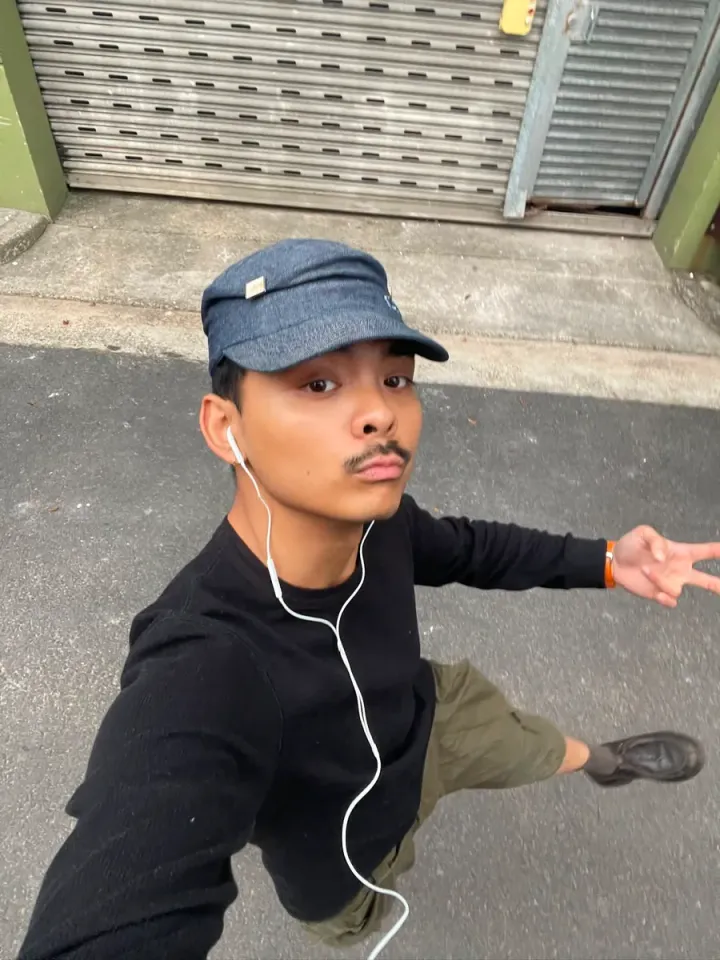
The businessman says be sensible. The kid says draw anyway. On his good days Migu lets them argue, and makes his work in the space their argument leaves behind. It's why his photograph over there is printed and shredded and printed again. The businessman sees waste. The kid sees a magic trick. They are both right.
This is where he is now. It is probably where you are too, reading this.
KEEP UP WITH MIGU:@migumind ↗SAY HI →